


Music producers often work quietly behind the scenes while shaping the soundtracks millions love. Yet, many producers earn only 2 to 5 percent of a track’s revenue, even when their creative input defines the song. You might expect bigger rewards for such essential work, but the real surprise is how royalty payments create both security and inspiration for producers who might otherwise walk away from the craft.
Table of Contents
- What Are Royalties For Producers?
- The Importance Of Royalties In Music Production
- Types Of Royalties: How They Differ And Apply
- The Royalty Distribution Process Explained
- Real-World Examples Of Royalties In Action
Quick Summary
| Takeaway | Explanation |
|---|---|
| Producers earn royalties from multiple sources | They receive compensation through master recording, publishing, and sync licensing royalties for their contributions. |
| Royalty rates typically range from 2% to 5% | Producers negotiate rates based on their reputation and the artist’s popularity, impacting overall earnings. |
| Royalties provide financial stability for producers | Ongoing royalty payments enable producers to invest in future projects and sustain their careers. |
| Collecting royalties requires meticulous tracking | Producers must monitor their works across platforms to ensure accurate royalty allocation and payment. |
| Sync licensing can lead to substantial income | Licensing music for visual media often yields higher earnings than traditional streaming royalties, making it a valuable revenue stream. |
What are Royalties for Producers?

In the sprawling universe of music creation, producers play a critical role that often goes unsung. Royalties for producers are essentially financial compensation for their creative contributions to recording and producing music tracks. Think of them as the behind-the-scenes wizards who transform raw musical ideas into polished sonic experiences.
Understanding Producer Royalty Basics
Producer royalties represent a percentage of revenue generated from music recordings, compensating these talented professionals for their technical expertise, creative input, and professional sound engineering skills. Unlike performers who earn royalties from live performances or streaming, producers typically receive royalties directly connected to record sales, digital streams, and licensing agreements.
Key components of producer royalties include:
- Master Recording Royalties: Direct earnings from the sale and streaming of recorded music
- Publishing Royalties: Compensation for creative contributions to song composition
- Sync Licensing Royalties: Earnings from music used in films, advertisements, or television shows
Negotiating Producer Royalty Rates
Royalty rates for producers can vary dramatically based on factors like the artist’s popularity, the producer’s reputation, and specific contractual agreements. Typically, producers might negotiate royalty rates ranging from 2% to 5% of the record’s revenue. Established producers working with major artists could potentially secure higher percentages.
Interested in understanding how to maximise your Music Promotion opportunities? Music Gateway offers comprehensive services designed to help artists and producers navigate the complex landscape of music industry royalties and revenue streams.
Ready to take your music career to the next level? Join Music Gateway and unlock professional tools to manage your musical journey effectively.
The Importance of Royalties in Music Production

In the intricate world of music creation, royalties serve as the financial lifeblood that sustains and motivates producers. These monetary returns are not merely payments but fundamental recognition of a producer’s creative expertise and professional contributions.
Economic Sustainability for Producers
Royalties represent more than just income they are a critical mechanism for ensuring long-term economic viability for music producers. Without consistent royalty streams, talented producers would struggle to continue investing time and resources into creating high-quality musical productions. Each royalty payment represents direct compensation for intellectual and creative labour, enabling producers to fund future projects, upgrade equipment, and maintain their professional careers.
Key economic benefits of royalties include:
- Supporting ongoing creative work
- Providing financial stability
- Recognising professional contributions
- Incentivising innovation in music production
Creative Ecosystem and Professional Development
Royalties function as more than financial transactions they are fundamental to maintaining a healthy creative ecosystem. By ensuring producers receive fair compensation, the music industry creates an environment that encourages continuous innovation and artistic excellence. Emerging producers can see a clear pathway to professional success, knowing their creative contributions will be financially valued.
Want to explore how technology is transforming creative industries? Check out our insights on AI in creative fields and discover how innovation is reshaping artistic landscapes.
Producers invest countless hours crafting sonic experiences that connect emotionally with listeners. Royalties represent a critical acknowledgement of this profound creative process, ensuring that musical talent continues to be nurtured and celebrated.
Ready to take control of your music career? Join Music Gateway and unlock professional tools designed to support your artistic journey.
Types of Royalties: How They Differ and Apply
The music industry operates through a complex web of financial streams, with royalties serving as the critical mechanism that ensures artists and producers receive fair compensation for their creative work. Understanding the nuanced landscape of royalty types is fundamental for any music professional seeking to navigate their financial potential.
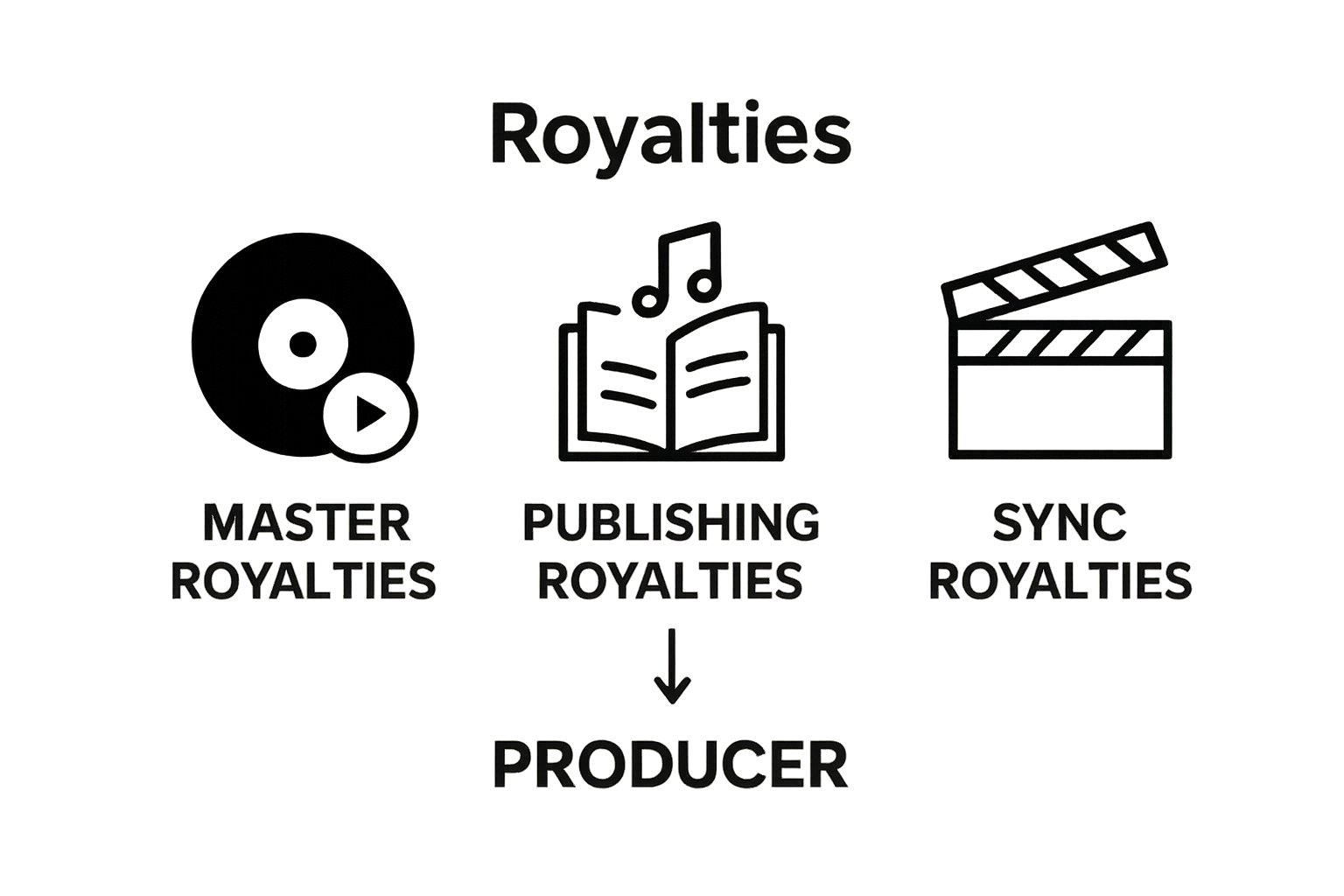
Master Recording Royalties
Master recording royalties represent the primary revenue stream directly connected to sound recordings. These royalties are generated whenever a track is sold, streamed, or reproduced across various platforms. Producers typically earn a percentage of these royalties based on their contractual agreements, with rates varying depending on their reputation and the specific project.
Key characteristics of master recording royalties include:
- Earnings from digital streaming platforms
- Physical album and single sales
- Digital download revenues
- Reproduction rights for recordings
Performance and Sync Licensing Royalties
Beyond master recording royalties, producers can also earn through performance and sync licensing royalties. Performance royalties are generated when a track is played publicly through radio, live venues, or digital streaming services. Sync licensing royalties, however, represent payments for using music in visual media like films, television shows, advertisements, and video games.
Want to explore how Music Promotion can help amplify your royalty potential? Our comprehensive services are designed to maximise your music’s reach and financial opportunities.
Publishing and Mechanical Royalties
Publishing royalties emerge when a producer contributes to the compositional aspects of a track, rewarding their creative input beyond sound engineering. Mechanical royalties are generated through mechanical reproduction rights, covering scenarios like physical album sales, digital downloads, and streaming platform plays.
Producers must understand that each royalty type represents a unique revenue stream, requiring specific tracking and collection strategies. Navigating these financial channels demands both creative talent and strategic business acumen.
The table below summarises the primary types of royalties producers can earn in the music industry, highlighting their sources and key characteristics for easy comparison.
| Royalty Type | Source of Revenue | Key Characteristics |
|---|---|---|
| Master Recording Royalties | Record sales, digital streams, downloads | Percentage of revenue from sound recordings; depends on contracts |
| Performance Royalties | Public play (radio, live venues, streaming) | Generated by public performances and broadcasting of the track |
| Sync Licensing Royalties | Use in films, TV, advertisements, games | Payments for allowing music in visual media; often higher than streaming |
| Publishing Royalties | Song composition credit | Compensation for creative input into composition; linked to publishing |
| Mechanical Royalties | Physical/digital reproductions | Arise from physical and digital sales, plus streaming mechanisms |
Ready to take control of your music career? Join Music Gateway and unlock professional tools designed to support your artistic and financial journey.
The Royalty Distribution Process Explained

The journey of music royalties from creation to distribution is a complex labyrinth that requires precision, legal understanding, and strategic management. Producers and artists must navigate this intricate financial ecosystem to ensure they receive fair compensation for their creative work.
Collection and Tracking Mechanisms
Royalty collection begins with meticulous tracking of musical works across multiple platforms and performance channels. Performing rights organizations, digital streaming platforms, and record labels play crucial roles in monitoring and documenting where and how music is consumed. These organizations use sophisticated digital tracking systems to record every stream, download, broadcast, and public performance.
Key elements of royalty tracking include:
- Digital streaming platform reports
- Radio and public performance logs
- Physical and digital sales records
- Synchronization licensing documentation
Rights and Revenue Allocation
Once collected, royalties are distributed through a complex allocation process that considers multiple factors. Contractual agreements between producers, artists, record labels, and publishers determine the specific percentage each party receives. This allocation involves detailed calculations that account for recording costs, publishing rights, and individual contributions to the musical work.
Want to maximise your Music Promotion potential and understand royalty distribution better? Our comprehensive services help artists navigate these intricate financial landscapes.
Legal and Administrative Processes
The final stage of royalty distribution involves rigorous legal and administrative processes. Performing rights organizations and specialized royalty collection agencies ensure that funds are accurately distributed to rights holders. Producers must maintain detailed documentation, register their works, and understand the specific terms of their contracts to guarantee proper compensation.
Navigating royalty distribution requires a blend of creative talent and business acumen. Successful music professionals invest time in understanding these financial mechanisms to protect their artistic and economic interests.
The following table outlines the stages of the royalty distribution process for music producers, clarifying the key actors and actions at each step for clearer understanding of the system.
| Distribution Stage | Description | Key Actors Involved |
|---|---|---|
| Collection & Tracking | Monitoring music usage and recording data across platforms | Performing rights organisations, labels, platforms |
| Revenue Allocation | Calculating payments according to contracts and contribution levels | Producers, artists, labels, publishers |
| Legal & Administration | Registering works and distributing funds to rights holders | PROs, royalty agencies, legal representatives |
Ready to take control of your music career? Join Music Gateway and unlock professional tools designed to support your artistic and financial journey.
Real-World Examples of Royalties in Action
Royalties transform from abstract financial concepts into tangible income streams when applied in real-world music production scenarios. Understanding practical examples illuminates how producers actually earn money through their creative contributions and strategic collaborations.
Streaming Platform Royalty Scenarios
Digital streaming platforms have revolutionised how producers generate income. Consider a producer who collaborates on a track that becomes a global hit. Through platforms like Spotify, they might earn royalties based on millions of streams, with earnings calculated through complex algorithmic calculations that consider factors like stream duration, geographical location, and subscriber tier.
Typical streaming royalty scenarios include:
- Viral tracks generating significant monthly revenue
- Consistent performance across multiple international markets
- Collaborative projects splitting royalties between artists and producers
- Niche genre tracks with dedicated listener bases
Sync Licensing Success Stories
Sync licensing represents another powerful royalty generation mechanism. Producers can earn substantial revenues when their music is licensed for television shows, advertisements, films, or video games. A single placement in a popular Netflix series or a major brand commercial can generate significant financial returns, sometimes eclipsing traditional streaming revenues.
Want to amplify your Music Promotion potential and explore sync licensing opportunities? Our comprehensive services connect talented producers with industry decision makers.
Collaborative Royalty Arrangements
Complex collaborative projects demonstrate the intricate nature of royalty distributions. In scenarios where multiple producers, songwriters, and artists contribute to a single track, royalties are meticulously divided based on predefined contractual agreements. These arrangements require transparent communication and precise documentation to ensure fair compensation for all creative contributors.
Successful producers understand that royalties represent more than just financial transactions they are recognition of creative expertise and professional skill.
Ready to take control of your music career? Join Music Gateway and unlock professional tools designed to support your artistic and financial journey.
Unlock Your Earning Potential with Professional Support
Navigating the complexities of producer royalties can feel overwhelming for many independent and emerging artists. As the article highlights, grasping the nuances of master recording royalties, publishing, and sync licensing is essential, yet often challenging without the right tools and support. Questions about fair compensation, tracking multiple revenue streams, and managing legal agreements can easily stand in the way of your success.
If you are ready to streamline your royalty management and ensure every creative contribution is properly recognised, it is time to discover how easy music career growth can be with the right partner. Visit Music Gateway to access intuitive tools for music promotion, distribution, and sync licensing. Benefit from real success stories and tap into step-by-step resources designed for the modern producer. Do not let revenue slip through your fingers. Start your journey today and turn your creative work into long-term financial security.
Frequently Asked Questions
What are producer royalties in the music industry?
Producer royalties are financial compensations paid to producers for their creative contributions to music recordings. They represent a percentage of the revenue generated from record sales, digital streams, and licensing agreements.
How do I negotiate royalty rates as a music producer?
Negotiating royalty rates typically involves assessing factors such as the artist’s popularity, your reputation as a producer, and specific contractual terms. Rates usually range from 2% to 5% of the record’s revenue, with potential for higher rates for established producers.
What types of royalties can producers earn?
Producers can earn different types of royalties, including master recording royalties from sales and streams, performance royalties from public play, sync licensing royalties from music used in visual media, and publishing royalties for contributions to song composition.
How does the royalty distribution process work for music producers?
The royalty distribution process involves collecting and tracking usage data from multiple platforms, allocating revenue based on contractual agreements, and navigating legal and administrative processes to ensure proper compensation for producers and artists.