


Modern songwriting is more than just stringing chords and lyrics together. Many hit songs go through five or more major rewrites before they see the light of day. Most people believe that inspiration alone creates brilliant music, but the real secret lies in deliberate self-analysis, radical experimentation, and a willingness to tear apart your own work.
This fresh approach transforms hesitant songwriters into confident musical architects ready to surprise even themselves.
Table of Contents
- Step 1: Analyse Your Current Songwriting Skills
- Step 2: Set Specific Songwriting Goals
- Step 3: Experiment with Different Song Structures
- Step 4: Incorporate Feedback and Collaborate
- Step 5: Revise and Polish Your Songs
Quick Summary
| Key Point | Explanation |
|---|---|
| 1. Conduct a thorough self-assessment | Evaluate your existing songs to identify patterns and areas for improvement in your songwriting. |
| 2. Set specific, measurable goals | Define clear objectives for your songwriting growth to track your progress and stay motivated. |
| 3. Experiment with song structures | Challenge traditional formats by deconstructing and reimagining how songs can be arranged for freshness. |
| 4. Seek constructive feedback | Create a circle of trusted peers to provide honest input, fostering growth through collaboration and dialogue. |
| 5. Revise your songs meticulously | Treat revisions as essential transformation processes, refining your lyrics and arrangements for maximum impact. |
Step 1: Analyse Your Current Songwriting Skills

Songwriting is an art that demands constant self-reflection and improvement. Before you can elevate your craft, you need a brutally honest assessment of where you currently stand. Think of this as your musical health check – no sugar coating, just raw, unfiltered evaluation.
Start by gathering a collection of your existing songs. Pull together everything you’ve written in the past year, even those half-finished tracks gathering digital dust in your notes app. Your goal is to create a comprehensive snapshot of your current songwriting landscape. Listen to each piece with fresh ears, as if you’re hearing them for the first time. Pretend you’re a music critic who doesn’t know you personally.
While listening, pay attention to recurring patterns in your songwriting. Are your chord progressions predictable? Do your lyrics sound like carbon copies of previous tracks? Notice the structural elements: how you build verses, craft choruses, and transition between sections. Discover more about originality in music to help you identify areas where you might be playing it too safe.
Critical elements to assess include:
- Lyrical depth and authenticity
- Melodic complexity
- Emotional resonance
- Structural innovation
- Thematic consistency
Don’t just listen passively. Take detailed notes. Grab a notebook and ruthlessly document your observations. What makes your songs unique? Where do they feel generic? Which tracks make you cringe, and which genuinely surprise you? This isn’t about beating yourself up but understanding your current musical DNA.
Remember, self-analysis isn’t a one-time event. Create a quarterly review ritual where you revisit your work, track your progress, and continuously recalibrate your songwriting approach. True artistry emerges from persistent, honest self-evaluation and a willingness to push beyond your comfort zone.
By the end of this step, you should have a clear, somewhat uncomfortable but enlightening map of your current songwriting skills. Embrace the discomfort – it’s the first step towards genuine musical growth.
Step 2: Set Specific Songwriting Goals

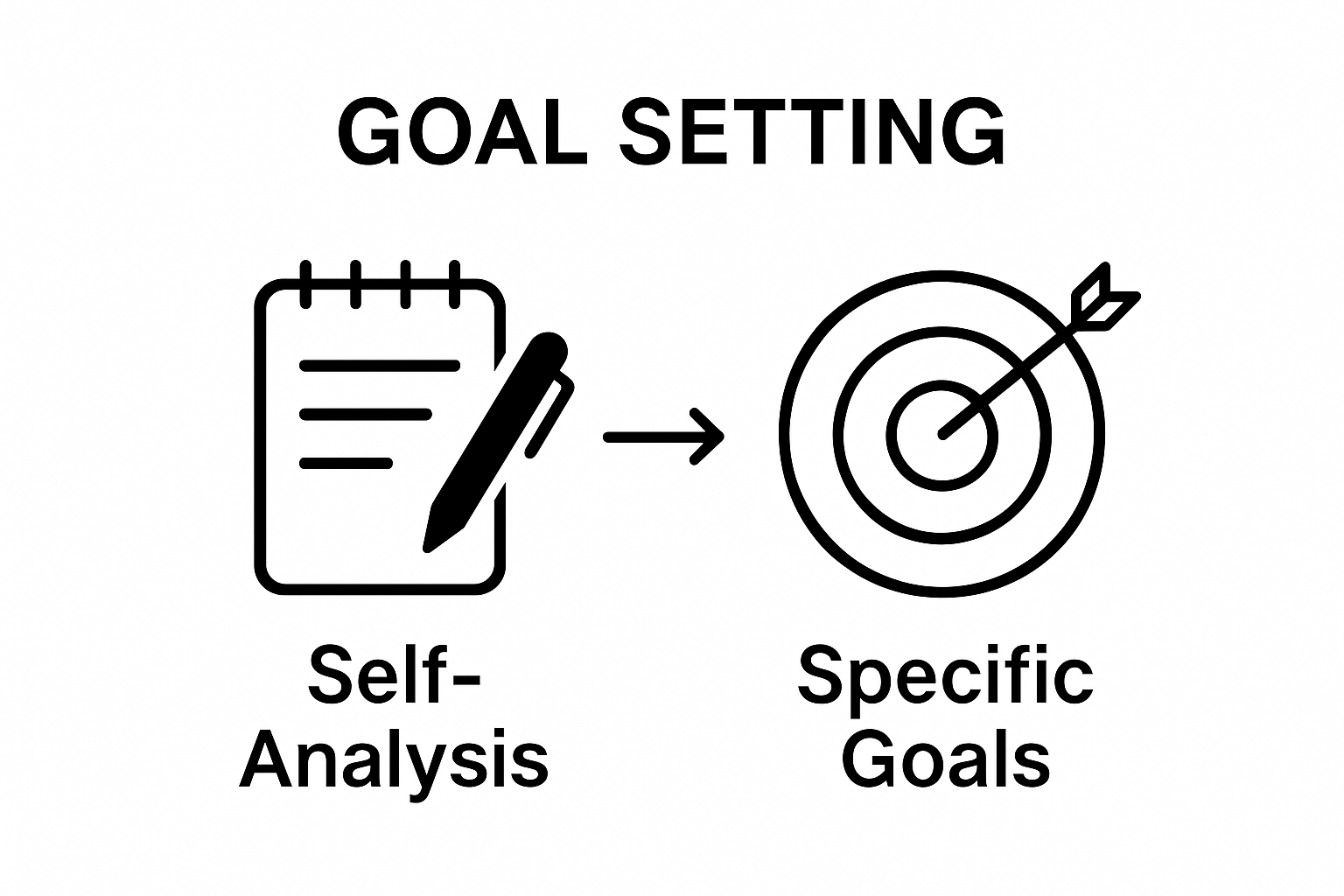
Now that you’ve brutally dissected your current songwriting skills, it’s time to chart a strategic path forward. Setting goals isn’t about wishful thinking – it’s about creating a roadmap that transforms your musical potential into tangible achievements. Vague intentions are the enemy of progress.
Start by establishing concrete, measurable objectives that challenge but don’t overwhelm you. Instead of saying “I want to be a better songwriter,” frame your goals with precision. For instance, “I will write one complete song per month with a minimum of three unique chord progressions” or “I will collaborate with two different musicians this quarter to expand my songwriting perspective”.
Improve your reach on music platforms by aligning your songwriting goals with practical career milestones. This might mean targeting specific playlist submissions, writing songs tailored to sync licensing opportunities, or developing a distinctive sound that sets you apart from other indie artists.
Your goals should encompass multiple dimensions of songwriting growth:
- Technical skill development
- Creative exploration
- Professional networking
- Performance and release strategies
Break down each goal into actionable micro-steps. If your overarching aim is to write more emotionally authentic lyrics, your micro-steps might include reading poetry, keeping a daily journaling practice, or studying songwriters known for their lyrical depth. The key is transforming abstract ambitions into a structured action plan.
Consider creating a songwriting contract with yourself. Write down your goals, sign and date the document, and place it somewhere visible. This might sound silly, but the psychological commitment can be surprisingly powerful. Track your progress monthly, celebrating small victories and recalibrating when necessary.
Remember that goals are living documents. They should flex and evolve as you develop. What seems impossible today might become your warm-up routine in six months. Stay flexible, but remain committed to consistent growth. By the end of this step, you should have a clear, written set of specific, measurable songwriting goals that excite and slightly terrify you – that’s when you know you’re on the right track.
Step 3: Experiment with Different Song Structures
Songwriting isn’t about following a rigid formula – it’s about creative rebellion. Conventional song structures are merely suggestions, not commandments. Your mission now is to deconstruct and reimagine how a song can be built, challenging everything you thought you knew about musical composition.
Start by understanding traditional structures – verse, chorus, bridge – then systematically dismantle them. Listen to artists who play with form: Radiohead, Bon Iver, Frank Ocean. They don’t just write songs; they architect sonic experiences. Learn more about song arrangement techniques to expand your musical toolkit.
Practical experimentation means pushing boundaries. Try writing a song that begins with the chorus, or crafts a narrative that deliberately avoids repeating melodic themes. Imagine your song as a conversation that doesn’t follow expected rhythms. What happens if your bridge becomes the emotional centrepiece instead of a transitional element?
Consider these structural experiments:
- Reverse the traditional verse-chorus progression
- Create a song with no repeated sections
- Write a track that morphs genre midway
- Construct a piece using unconventional time signatures
Recording technology is your playground. Digital audio workstations allow unprecedented flexibility in song construction. Use plugins, loop mechanisms, and editing tools to deconstruct traditional song architecture. Chop up recordings, rearrange segments, create unexpected sonic landscapes.
Don’t be precious about your initial drafts. Destroy and rebuild repeatedly. Each iteration strips away musical preconceptions, revealing more authentic expression. Some experiments will feel like glorious failures – and that’s precisely the point. Musical innovation emerges from controlled chaos.
Document your structural explorations. Keep a digital folder of these experimental tracks, noting what worked, what collapsed spectacularly, and why. This archive becomes your personal songwriting laboratory, tracking your evolution from conventional composer to true musical architect.
Below is a comparison of common methods for experimenting with song structure, summarising types of experimentation and their intended creative outcomes.
| Experimentation Method | Description | Creative Outcome |
|---|---|---|
| Reverse verse-chorus progression | Swap the usual order so chorus appears before verses | Fresh perspective and surprise |
| No repeated sections | Avoid repeating any musical or lyrical segment | Greater narrative coherence |
| Genre morphing | Start in one genre, shift into another mid-song | Unpredictable listening journey |
| Unconventional time signatures | Employ non-standard time patterns (e.g., 5/4, 7/8) | Adds rhythmic distinctiveness |
| Start with the chorus | Introduce main hook immediately rather than building up to it | Immediate engagement |
| Bridge as emotional core | Make the bridge the main emotional climax rather than a transition | Heightened dramatic impact |
By the end of this step, you should have multiple song drafts that look nothing like your original compositions. If they make you slightly uncomfortable and wildly excited, you’re on the right track.
Step 4: Incorporate Feedback and Collaborate

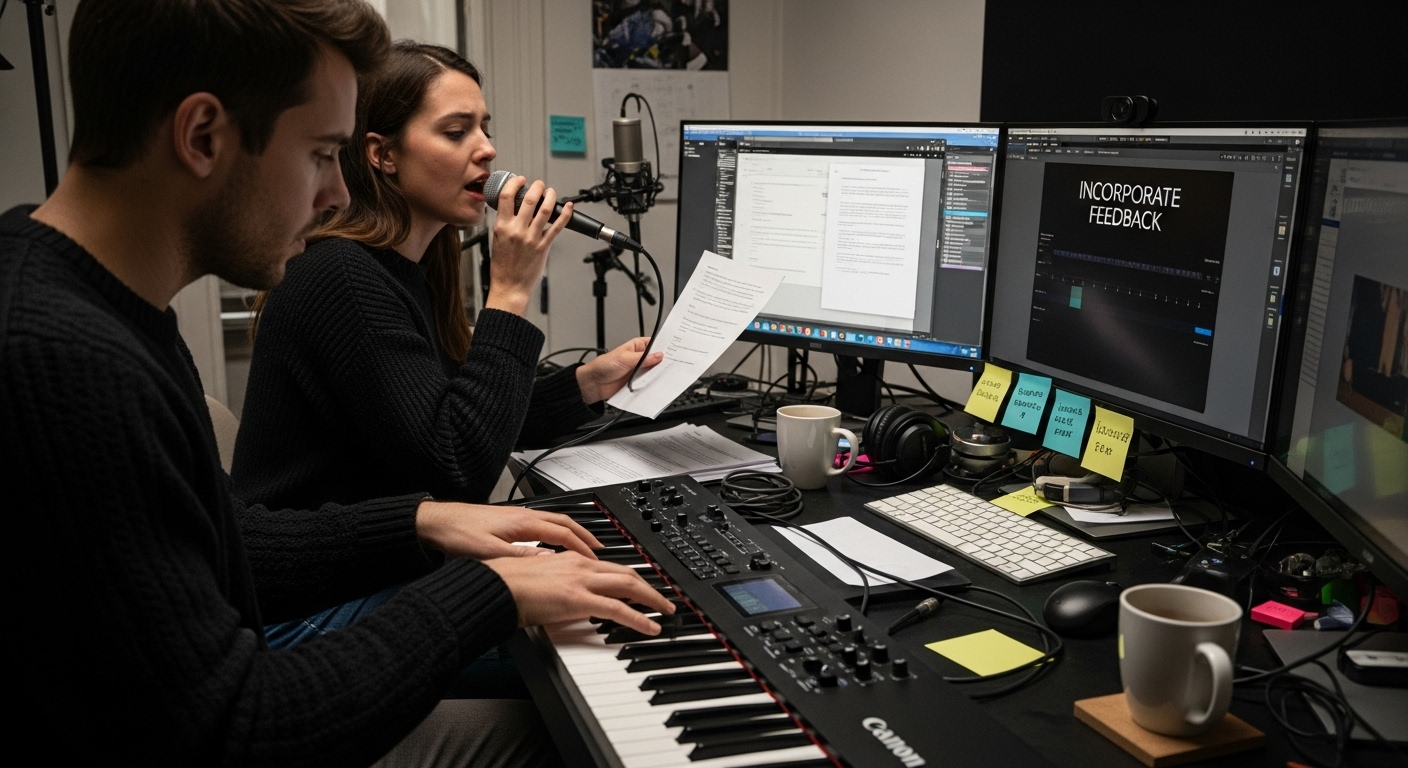
Isolation is the silent killer of creative potential. Your songs are not precious artifacts to be protected, but living organisms that grow through interaction. Feedback isn’t criticism – it’s the rocket fuel for your musical evolution.
Start by creating a trusted circle of musical peers who will give you brutally honest, constructive input. These aren’t your cheerleading mates who’ll smile and nod, but fellow musicians who understand the craft. Seek out songwriters slightly ahead of you in their musical journey – they’ll provide insights that are both aspirational and achievable. Learn techniques for musical collaboration that can dramatically expand your creative horizons.
When soliciting feedback, provide specific questions. Instead of asking “What do you think?”, request targeted insights: “Does the bridge feel emotionally consistent with the verse?” or “Is the narrative arc clear?” This approach transforms vague comments into actionable intelligence.
Consider these feedback channels:
- Local songwriting workshops
- Online musician forums
- Music production communities
- Collaborative songwriting platforms
- Peer review groups
Collaboration isn’t just about receiving critique – it’s about active musical dialogue. Seek out musicians with complementary skills. A guitarist might illuminate rhythmic possibilities you’ve overlooked. A vocalist could reveal melodic potential hidden in your chord progressions. The best collaborations create something neither artist could have produced alone.
Develop a thick skin. Not all feedback will resonate, and that’s okay. Learn to distinguish between constructive criticism that challenges you to grow and mere opinion. The goal is not to please everyone, but to refine your unique musical voice.
Practical collaboration means being generous with your own insights too. Offer meaningful feedback to other musicians. This reciprocal approach builds genuine connections and creates a supportive musical ecosystem. You’re not just improving your songs – you’re contributing to a creative community.
By the end of this step, you should have multiple pieces of external feedback, at least one collaborative project in progress, and a renewed sense of your music’s potential. Remember: great songs are rarely born in silence – they emerge through conversation, challenge, and collective creativity.
Step 5: Revise and Polish Your Songs
Revision isn’t about perfection – it’s about transforming raw potential into a refined musical statement. Your first draft is a rough diamond, not the final jewel. This stage separates hobbyist musicians from serious artists who understand that great songs are sculpted, not simply birthed.
Approach your revision like a surgical procedure. Distance yourself emotionally from the initial composition. Wait at least a week after receiving feedback before returning to your track. This temporal separation allows you to listen with fresh, objective ears. Learn about releasing music professionally to understand the importance of meticulous preparation.
Start with lyrical precision. Every word must earn its place. Cut anything that doesn’t advance the song’s emotional narrative. If a line sounds clever but doesn’t serve the core message, eliminate it ruthlessly. Your lyrics should feel like a laser-focused conversation, not a meandering monologue.
Consider these revision focal points:
- Emotional consistency
- Narrative clarity
- Rhythmic tightness
- Melodic memorability
- Thematic coherence
Musical arrangement demands equal scrutiny. Listen for moments where the instrumentation feels cluttered or distracting. Sometimes removing elements creates more impact than adding complexity. A single, perfectly placed guitar line can communicate more than a wall of sound.
Technical refinement matters. Examine your track’s dynamics, ensuring each section breathes and builds naturally. Pay attention to transitions between sections – they should feel like intentional journeys, not abrupt interruptions. Use your digital audio workstation to make microscopic adjustments to timing, volume, and effects.
Don’t be afraid of radical surgery. If a song isn’t working, be prepared to completely deconstruct and rebuild. Some of the most compelling tracks emerge from multiple iterations, where the final version bears little resemblance to the original draft.
By the end of this step, your song should feel simultaneously familiar and surprising. It should communicate its emotional core with crystal clarity, every element serving a deliberate purpose. If listening to the track makes you feel something profound – pride, vulnerability, excitement – you’re on the right track.
This revision checklist table provides a concise overview of elements to focus on when refining your songs, ensuring each area receives detailed attention during the polishing process.
| Revision Focus | What to Review | Desired Effect |
|---|---|---|
| Lyrical precision | Eliminate unnecessary words or unclear imagery | Clear, impactful storytelling |
| Emotional consistency | Ensure feelings remain genuine and unified | Cohesive emotional journey |
| Narrative clarity | Verify the storyline makes sense and flows | Listener engagement and meaning |
| Rhythmic tightness | Check for awkward or inconsistent rhythms | Smooth, professional sound |
| Melodic memorability | Strengthen melodies to avoid blandness | Catchy and memorable tune |
| Thematic coherence | Align all song parts with the central theme | Stronger artistic statement |
Ready To Transform Your Songwriting Into Real Industry Success?
You have spent time analysing your songwriting, setting specific goals, and experimenting with bold new structures. Still, it often feels like your work remains unheard, surrounded by countless other talented voices. The real challenge is not just perfecting your tracks but making sure they reach the audience and recognition your creativity deserves. Independent artists frequently struggle with the leap from crafted songs to actual exposure and measurable growth. Getting your music onto playlists or finding strategic promotional channels can feel like another mountain to climb.
Let Music Gateway be the bridge between your artistry and opportunity. With industry-standard music promotion services that align perfectly with the needs of independent creators, you can elevate your journey from experimentation to professional results. Whether you need playlist support, tailored digital campaigns or expert feedback for your next release, our solutions simplify every step of the promotional process. Do not let your best tracks go unnoticed. Start now by visiting Music Gateway and tap into tools designed to help your songs cut through and connect. Your next breakthrough could be one click away.
Frequently Asked Questions
How can I assess my current songwriting skills?
To analyse your songwriting, gather all your songs from the past year and listen to them with a critical ear, noting patterns in lyrics, melodies, and structures. Document your observations to identify strengths and areas for improvement.
What are some effective songwriting goals for independent artists?
Set specific, measurable, and achievable goals, such as writing a song each month or collaborating with other musicians. Break these goals down into smaller steps to create a clear action plan.
How can I incorporate feedback into my songwriting process?
Seek constructive feedback from trusted peers or fellow musicians, asking specific questions about your work. Use their insights to refine your compositions and embrace collaboration to enhance your creative output.
What should I focus on when revising my songs?
During revision, pay attention to lyrical precision, emotional consistency, and the clarity of your song’s narrative. Ensure that every musical element serves a specific purpose, and don’t hesitate to make radical changes if necessary.