

Rock genres have forever shaped the sound of youth culture. Over 250 distinct rock subgenres are now recognised worldwide, and each one has its rebellious flavour. However, most musicians spend years chasing a signature sound without ever fully understanding how these genres originated or what makes each subgenre unique. Grasping these foundations can be the key to real creative freedom.
Table of Contents
- Understanding The Foundations Of Rock Genres
- Popular Rock Subgenres And Their Key Features
- How Rock Genres Influence Songwriting And Production
- Choosing The Right Genre For Your Music Career
Quick Summary
| Takeaway | Explanation |
|---|---|
| Understand rock’s musical roots. | Recognising rock’s origins from blues, country, and gospel enhances creative expression. |
| Explore diverse rock subgenres. | Each subgenre, from punk to progressive rock, offers unique styles and emotional approaches for artists. |
| Align technical skills with genres. | Identify your strengths, like instrumental skill or songwriting style, to find the right rock genre fit. |
| Prioritise emotional communication in production. | Using genre-specific production techniques enhances the emotional impact of your music. |
| Strategically choose your genre. | Select a genre that not only reflects your artistic identity but also aligns with career goals and audience engagement. |
Understanding the Foundations of Rock Genres
Rock music isn’t just a genre. It’s a rebellious sonic rebellion that erupted from the musical melting pot of mid-20th-century America, transforming from underground whispers to a global cultural phenomenon. Understanding rock genres means diving into a world where sound meets attitude, where musical innovation collides with raw emotional expression.
The Historical Roots of Rock
At its core, rock emerged as a powerful fusion of rhythm and blues, country, gospel, and early electric blues. Musicians like Chuck Berry and Elvis Presley weren’t just performers. They were musical alchemists transforming traditional sounds into something entirely revolutionary. These pioneers understood that rock was more than music. It was a statement of youth culture, defiance, and personal freedom.
The genre’s DNA is complex. Blues provided the emotional depth and lyrical complexity. Country music contributed storytelling and distinctive guitar techniques. Gospel infused, passionate vocal styles. When these elements collided, rock was born – a sound that was simultaneously familiar and completely radical.
Musical Characteristics That Define Rock
What truly distinguishes rock is its fundamental musical characteristics. Typically featuring electric guitar as the primary instrument, rock relies on strong rhythmic patterns, often driven by powerful drum beats and bass lines. The standard rock band configuration – lead guitar, rhythm guitar, bass, and drums – became the blueprint for countless musical iterations.
Harmonic structures in rock tend to be relatively straightforward, focusing on power chords and progressions that create an immediate emotional impact. Distortion, amplification, and aggressive playing techniques transformed these simple musical foundations into something visceral and compelling. Discover more about rock’s musical evolution and understand how independent musicians can harness these foundational elements.
The Importance of Genre Understanding for Independent Musicians
For independent musicians, understanding rock genres isn’t just academic. It’s a strategic approach to musical creativity. Each subgenre – from punk’s raw aggression to progressive rock’s complex arrangements – offers unique tools for artistic expression. Knowing these genres allows musicians to deconstruct, remix, and innovate.
By comprehending the historical and musical foundations of rock, independent artists can do more than imitate. They can contribute to the ongoing evolution of this dynamic musical form. Rock has always been about pushing boundaries, challenging expectations, and creating something uniquely personal.
Whether you’re crafting intricate progressive rock arrangements or stripped-down garage rock anthems, understanding these foundations provides a roadmap for musical exploration. Rock isn’t just about technical skill. It’s about capturing a moment, expressing an emotion, and connecting with listeners on a profound level.
Ready to transform your musical journey? Join Music Gateway and unlock the tools that’ll help you navigate the exciting world of rock music.
Popular Rock Subgenres and Their Key Features
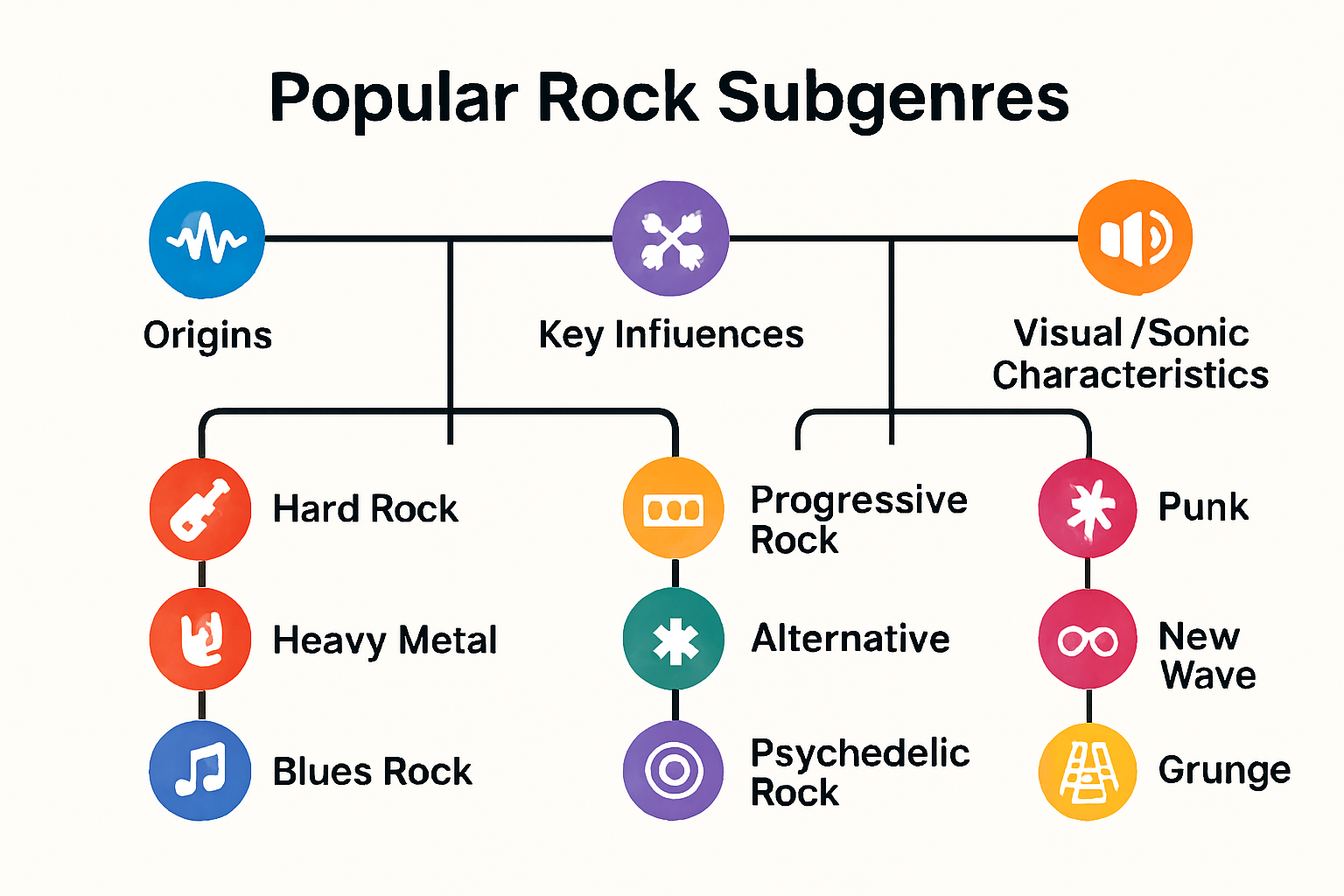
Rock music isn’t a monolithic entity but a vibrant tapestry of diverse subgenres, each with its distinctive sonic personality and cultural significance. Independent musicians seeking to carve their musical identity must understand these genres as more than just classifications. They are living, breathing musical ecosystems with unique characteristics, historical contexts, and artistic philosophies.
Below is a table summarising some key subgenres of rock discussed in this section, highlighting their main characteristics, historical context, and notable artists:
| Subgenre | Key Characteristics | Historical Context | Notable Artists |
|---|---|---|---|
| Punk Rock | Raw energy, fast tempo, simple chords, social themes | 1970s rebellion | Ramones, Sex Pistols |
| Alternative Rock | Indie sensibility, diverse arrangements, experimentation | 1980s-90s mainstream | R.E.M., Pixies |
| Hard Rock | Heavy guitar riffs, strong vocals, high amplification | 1970s stadium rock | Led Zeppelin, Aerosmith |
| Progressive Rock | Complex time signatures, long compositions, concept albums | 1970s art rock | Pink Floyd, Yes |
| Blues Rock | Blues-inspired guitar, improvisation, emotional vocals | 1960s-70s fusion | Eric Clapton |
The Rebellious Spectrum of Rock Subgenres
Rock’s incredible diversity means musicians have an expansive palette of sounds to explore. From the raw, aggressive energy of punk to the intricate arrangements of progressive rock, each subgenre represents a different approach to musical expression. Explore the fascinating world of experimental rock and discover how artists push the boundaries of traditional rock music.
Punk rock emerged as a visceral reaction against musical complexity, championing simplicity and unbridled emotional intensity. With lightning-fast tempos and stripped-down instrumentation, punk became a vehicle for social commentary and youthful rebellion. Bands like the Ramones and Sex Pistols transformed musical performance into a powerful statement of individual defiance.
Alternative rock, by contrast, offered a more nuanced approach. Emerging in the 1980s, this genre became a sanctuary for musicians rejecting mainstream rock’s commercial constraints. Bands like R.E.M. and Pixies crafted intricate soundscapes that blended indie sensibilities with sophisticated musical arrangements, creating a genre that celebrated artistic integrity over commercial success.
Technical Characteristics and Musical Innovation
Each rock subgenre brings unique technical approaches to music creation. Hard rock, for instance, emphasises powerful guitar riffs and intense vocal performances. Bands like Led Zeppelin and Aerosmith demonstrated how muscular instrumentation could create an immersive musical experience. Distortion, heavy amplification, and aggressive playing techniques became hallmarks of this genre.
Progressive rock took technical complexity to another level. Bands like Pink Floyd and Yes created sprawling musical narratives that challenged traditional song structures. Complex time signatures, extended instrumental sections, and conceptual albums became their trademark. Musicians in this genre viewed rock not just as entertainment but as a sophisticated art form capable of profound musical storytelling.
Artistic Expression and Genre Boundaries
For independent musicians, understanding rock subgenres means recognising that genre boundaries are fluid and permeable. Modern rock artists frequently blend elements from multiple subgenres, creating innovative hybrid sounds. This approach allows for unprecedented creative freedom.
Blues rock represents another fascinating intersection, where traditional blues structures meet rock’s energetic performance style. Artists like Eric Clapton demonstrated how deep musical traditions could be reinterpreted through a rock lens, creating something simultaneously familiar and revolutionary.
The beauty of rock lies in its constant evolution. Each subgenre represents a moment in musical dialogue, a conversation between tradition and innovation. Independent musicians aren’t just genre participants. They’re active contributors to an ongoing musical narrative.
Ready to begin your rock music journey? Join Music Gateway and connect with a community of passionate musicians who are redefining rock’s boundaries.
How Rock Genres Influence Songwriting and Production
Rock music is far more than just sound. It’s a complex ecosystem where songwriting techniques, production approaches, and genre expectations interweave to create powerful musical statements. For independent musicians, understanding how different rock genres fundamentally shape creative processes becomes crucial to developing a distinctive artistic voice.
The table below compares songwriting and production approaches across popular rock subgenres, providing an at-a-glance guide for independent musicians:
| Subgenre | Songwriting Approach | Production Style | Artistic Focus |
|---|---|---|---|
| Punk Rock | Direct, simple, raw | Minimalist, high energy | Authenticity, rebellion |
| Progressive Rock | Complex, conceptual | Sophisticated, layered | Musical narrative, virtuosity |
| Alternative Rock | Experimental, introspective | Indie, nuanced | Innovation, emotional depth |
| Hard Rock | Riff-driven, bold | Loud, polished, heavy | Power, intensity |
| Blues Rock | Blues-based, emotive | Organic, live feel | Expressiveness, tradition |
Songwriting Approaches Across Rock Genres
Each rock subgenre demands a unique songwriting philosophy. Punk rock prioritises raw emotional directness, often crafting songs with minimal chord structures and lyrics that prioritise social commentary or personal rebellion. The songwriting here is deliberately unpolished, valuing authenticity over technical perfection.
Progressive rock, by contrast, approaches songwriting as an intricate compositional journey. Musicians in this genre construct elaborate musical narratives, frequently incorporating complex time signatures, extended instrumental passages, and conceptual themes that transcend traditional verse-chorus structures. Explore the depths of genre-bending musical creativity and understand how different rock styles challenge conventional songwriting norms.
Alternative rock songwriters often blend introspective lyrics with unconventional melodic approaches. Bands like Pixies and Radiohead demonstrated how unexpected chord progressions and abstract lyrical concepts could create profoundly compelling musical experiences. The songwriting becomes a form of artistic experimentation, challenging listeners’ expectations.
Production Techniques and Genre Identity
Production isn’t just technical wizardry. It’s the sonic language through which rock genres communicate their essence. Hard rock productions emphasise powerful, aggressive sounds with heavily distorted guitars and thunderous drum tracks. Producers in this genre focus on creating a wall of sound that feels physically immersive.
Indie and alternative rock productions often prioritise authenticity and nuance. Producers in these genres use minimal processing, allowing the raw performance to shine through. Microphone placement, subtle compression, and carefully managed dynamics become critical tools for capturing emotional authenticity.
Experimental rock pushes production boundaries even further. Here, traditional recording techniques are merely starting points. Musicians might incorporate found sounds, electronic manipulations, or unconventional recording methods to create truly unique sonic landscapes. The production becomes an artistic statement in itself.
The Emotional Architecture of Rock Production
Beyond technical considerations, rock genre production is fundamentally about emotional communication. Blues rock productions, for instance, prioritise capturing the raw, visceral feeling of live performance. Vintage recording techniques, minimal overdubs, and a focus on organic sound become essential.
Metal and hard rock productions create sonic environments designed to provoke intense emotional responses. Massive guitar tones, carefully layered instrumental tracks, and aggressive mixing techniques transform recordings into immersive sonic experiences that feel larger than life.
Independent musicians should view genre production not as restrictive rules, but as a palette of creative possibilities. Understanding these sonic architectures allows artists to respectfully engage with tradition while pushing musical boundaries.
Choosing the Right Genre for Your Music Career
Choosing a musical genre isn’t just about sound. It’s a strategic decision that can profoundly shape an independent musician’s entire career trajectory. Rock music offers a vast landscape of possibilities, each subgenre representing not just a musical style but an entire ecosystem of artistic expression, audience expectations, and professional opportunities.
Understanding Your Artistic Identity
Discovering your musical genre requires deep self-reflection. It’s about understanding your unique artistic voice, technical strengths, and emotional resonance. Some musicians instinctively know their genre, while others must embark on a journey of musical exploration. Learn more about navigating musical genres and uncover the path to your authentic sound.
Punk rock might attract musicians with raw, unfiltered emotional energy and a desire to challenge societal norms. Progressive rock could be the perfect home for technically skilled musicians who view composition as a complex narrative journey. Alternative rock welcomes those who thrive on musical experimentation and unconventional storytelling.
Your musical influences play a crucial role. The artists who inspire you often hint at the genre where you’ll feel most comfortable. Pay attention to the bands that make your spine tingle, the recordings that feel like an extension of your musical imagination.
Technical Skills and Genre Alignment
Each rock genre demands specific technical capabilities. Hard rock and metal require exceptional instrumental precision and powerful vocal techniques. Indie rock might prioritise nuanced emotional expression over technical virtuosity. Punk rock values authenticity and energy over polished performance.
Assess your instrumental skills honestly. Are you a guitar virtuoso who can shred complex solos? Progressive rock might be your calling. Do you excel at creating atmospheric soundscapes? Experimental rock could be your perfect match. Your technical abilities shouldn’t limit you but should guide your genre exploration.
Consider also the production techniques associated with different genres. Some rock styles demand sophisticated recording approaches, while others celebrate raw, unprocessed sounds. Understanding these technical nuances helps you align your skills with the right musical ecosystem.
Career Considerations and Genre Strategy
Beyond artistic expression, genre selection impacts your professional opportunities. Different rock genres have varying audience sizes, industry connections, and potential for monetisation. Underground punk scenes offer incredible community and artistic freedom, but might have limited commercial potential. Alternative rock provides more diverse opportunities for musical innovation.
Networking becomes easier when you understand your genre’s specific ecosystem. Each rock subgenre has its community of musicians, venues, festivals, and digital platforms. By positioning yourself strategically within these networks, you increase your chances of finding collaborators, performance opportunities, and potential record label interest.
Remember that genre boundaries are fluid. Many successful musicians blend multiple rock styles, creating unique sonic identities. Your genre isn’t a restrictive label but a starting point for musical exploration.
Your musical journey is about authenticity, passion, and continuous growth. Don’t be afraid to experiment, evolve, and redefine your sound. The most compelling musicians are those who remain true to their artistic vision while fearlessly pushing genre boundaries.

Frequently Asked Questions
What are the main characteristics of rock music?
Rock music typically features electric guitars as the primary instrument, strong rhythmic patterns driven by bass and drums, and harmonic structures that focus on power chords. Its emotional intensity is enhanced by distortion and aggressive playing techniques.
How do different rock subgenres influence songwriting?
Each rock subgenre has its own songwriting approach, with punk rock prioritising raw emotional directness, progressive rock offering complex musical narratives, and alternative rock embracing introspective and experimental lyrics.
Why is understanding rock genres important for independent musicians?
Understanding rock genres allows independent musicians to explore their creative expression more effectively. Each subgenre offers unique tools for innovation, enabling musicians to deconstruct and merge styles that align with their artistic identity.
How does genre selection impact a musician’s career?
Genre selection affects professional opportunities, audience engagement, and networking. Different subgenres come with varying audience sizes and industry connections, which can influence a musician’s commercial potential and collaborative opportunities.
Take Your Unique Rock Sound to the Next Level
You have learned how understanding rock genres can unlock new creative possibilities and help you carve out your signature sound. Yet, even with this knowledge, standing out as an independent musician can feel overwhelming. Reaching the right listeners, securing meaningful exposure, and navigating music promotion are common barriers that many artists face, no matter how original their approach may be. Every rock subgenre, from punk to progressive, offers its landscape, but cutting through the noise requires targeted promotion and industry access.
Let your music reach audiences who truly appreciate your artistry. Music Gateway’s promotion services are built for independent artists ready to amplify their progress. With expertise in playlist submissions, digital advertising, and unique exposure channels for individual genres, this is your gateway to break into the next level. Start now at https://musicgateway.com/music-promotion and give your rock project the platform it deserves.
Recommended
- Music Genres Explained | Music Gateway
- Music Distribution vs Publishing | Music Gateway
- Independent Artist Marketing | Music Gateway
- Music Marketing Strategies | Мusic Gateway
- Authentic organic Spotify promotion