


Lyric writing holds the secret to unforgettable songs, connecting life’s rawest emotions to melody. You might think it’s all about clever rhymes or catchy choruses. Yet the reality is, over 80 per cent of chart-topping tracks owe their success to deeply personal storytelling rather than snappy wordplay. The best lyrics break all the rules and draw you in with honesty that resonates far beyond the first listen.

Table of Contents
- Understanding The Basics Of Lyric Writing
- Creative Approaches To Crafting Lyrics
- Editing And Refining Your Song Lyrics
- Common Mistakes To Avoid In Lyric Writing
Quick Summary
| Takeaway | Explanation |
|---|---|
| Write a song from personal experiences | Authenticity transforms emotions into universal stories, creating deeper listener connections. |
| Focus on structural integrity | Utilize a clear verse-chorus structure to engage listeners effectively and maintain narrative flow. |
| Engage multiple senses in writing | Describe emotions through sensory details to create immersive lyrical experiences that resonate universally. |
| Edit for precision and clarity | Review and refine lyrics to enhance emotional impact, removing unnecessary words and clichés for stronger communication. |
| Avoid common lyrical clichés | Strive for originality in expressions to ensure your lyrics evoke fresh emotions and relatable imagery. |
Understanding the Basics of Lyric Writing
Mastering lyric writing is like learning a secret language of emotional storytelling. Your words become the bridge connecting raw human experience to musical expression, transforming abstract feelings into tangible narratives that resonate deeply with listeners.
At its core, lyric writing isn’t just about rhyming words or creating catchy phrases – it’s about crafting genuine, powerful communication through music.
The Art of Personal Expression
Lyric writing begins with radical honesty. The most compelling songs emerge from authentic personal experiences, transforming individual moments into universal stories. Whether you’re exploring heartbreak, joy, confusion, or triumph, your unique perspective becomes the songwriting gold. Think of your lyrics as a musical diary – unfiltered, vulnerable, and unapologetically real.
Successful songwriters understand that personal specificity paradoxically creates a broader connection. When you detail a precise emotional landscape – the way sunlight catches your ex’s photograph, the precise feeling of disappointment after a dream slips away – listeners recognise themselves in your narrative. Your truth becomes their collective experience.
For aspiring lyricists, this means developing keen observational skills. Start carrying a notebook or use your smartphone to capture fleeting emotions, overheard conversations, or striking imagery. These fragments become raw material for potential lyrics. Discover our songwriting techniques that can help transform these glimpses into complete musical stories.
Structural Foundations of Compelling Lyrics
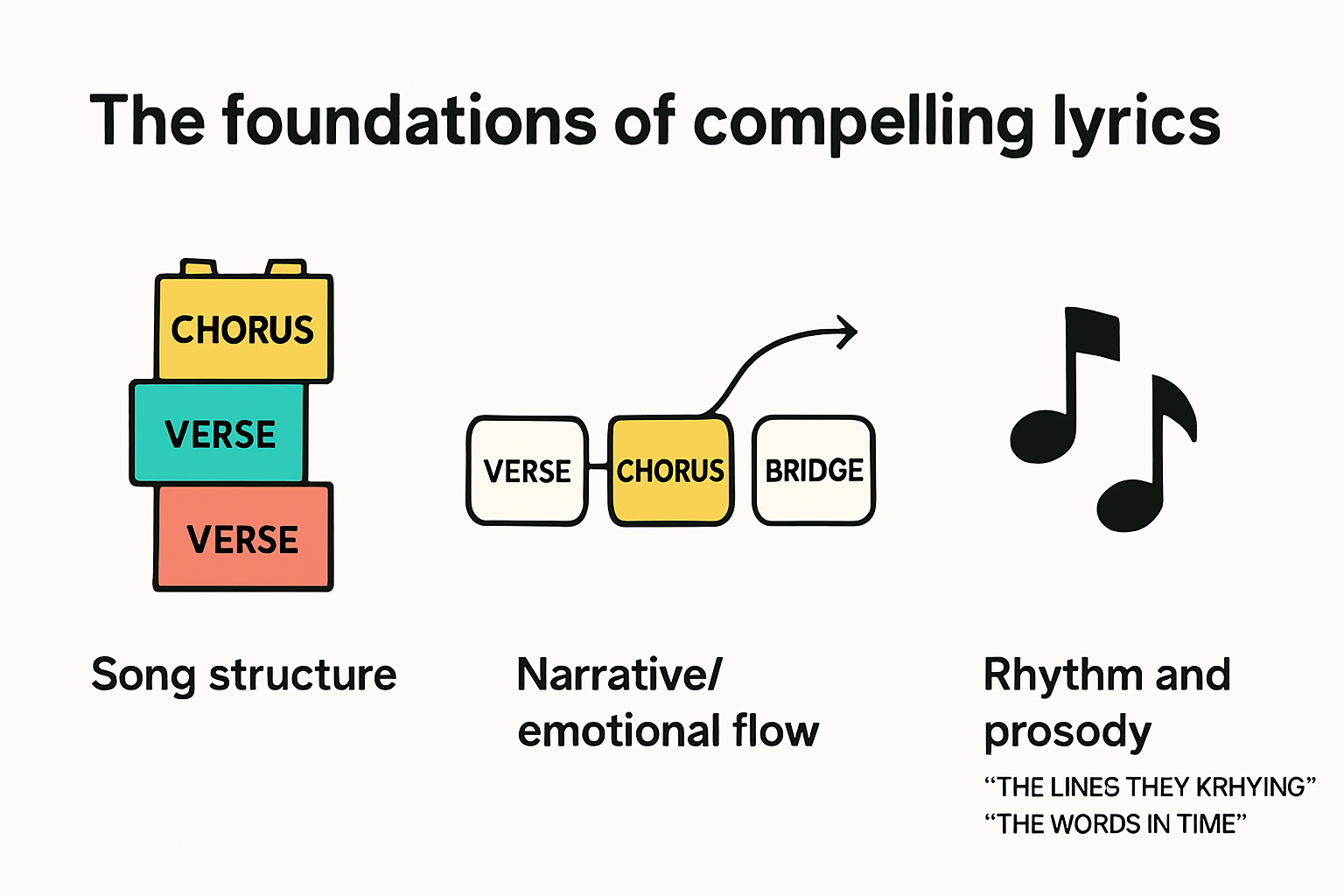
Lyric writing isn’t just emotional improvisation – it requires understanding fundamental structural principles. Effective lyrics typically follow specific patterns that guide listener engagement. Most popular song structures include verses that build narrative tension, choruses that provide emotional release, and bridges that offer unexpected perspective shifts.
Consider your lyrics like architectural plans. Verses are the foundational walls, establishing context and introducing characters or emotions. Choruses become the roof – the strongest, most memorable section that captures the song’s essential message. Bridges provide dynamic contrast, preventing musical monotony and offering listeners a moment of surprising reflection.
Pay attention to rhythm and prosody – how words naturally flow with musical beats. The best lyrics feel inevitable, as though the words couldn’t possibly exist in any other sequence. This requires careful word selection, understanding syllabic stress, and creating a seamless dance between linguistic meaning and musical cadence.
Here is a summary table outlining the main structural elements of compelling song lyrics and the role each part plays in crafting a memorable song:
| Structural Element | Purpose in Song Structure |
|---|---|
| Verse | Introduces context, characters, or emotions; builds narrative tension |
| Chorus | Delivers the song’s main message; provides emotional release |
| Bridge | Offers contrast and surprise; shifts perspective or emotion |
| Rhythm & Prosody | Ensures words flow naturally with melody; enhances the listening experience |
Technical Craft Meets Emotional Intuition
While technical skills matter immensely, exceptional lyric writing ultimately transcends mere technique. It’s about striking a delicate balance between calculated craft and spontaneous emotional truth. Study successful songwriters, analyse their approaches, but never lose sight of your unique voice.
Remember that great songs and great lyrics aren’t about displaying vocabulary prowess or creating unnecessarily complex metaphors. They’re about clarity, emotional precision, and creating moments of profound human connection. Sometimes the most powerful lines are deceptively simple – direct statements that cut straight to the heart of shared experience.
As you develop your lyric writing skills, embrace both discipline and vulnerability. Practice consistently, study the masters, but always leave room for raw, unfiltered emotion. Your most remarkable lyrics will emerge when technical skill meets genuine human experience.
Ready to transform your songwriting journey? Join Music Gateway and connect with a community of passionate musicians who are pushing creative boundaries every single day.
Creative Approaches to Crafting Lyrics

Lyric writing isn’t a mechanical process but an artistic adventure where creativity meets emotional intelligence. The most compelling songs emerge from unexpected perspectives, innovative techniques, and a willingness to experiment beyond traditional songwriting boundaries.
Breaking Traditional Lyrical Boundaries
Traditional songwriting often follows predictable patterns, but breakthrough artists understand that true creativity requires disrupting those very patterns. Think of your lyrics as a musical canvas where words aren’t just communicating stories but painting entire emotional landscapes.
One powerful technique involves shifting perspective unexpectedly. Instead of writing from a first-person narrative, try composing lyrics from an inanimate object’s viewpoint or a completely unexpected character. Imagine a song written from a street lamp’s perspective during a heartbreak, or a melody narrated by an abandoned photograph. Explore unconventional songwriting strategies that challenge traditional storytelling approaches.
Experimental lyricists frequently play with linguistic structures. They might deliberately misplace words, create intentional grammatical oddities, or use language in ways that defy conventional communication. This approach transforms lyrics from mere storytelling into abstract poetry, inviting listeners to interpret meanings personally.
Emotional Mapping and Sensory Writing
Advanced lyric writing goes beyond surface-level emotions. The most profound songs create immersive experiences by engaging multiple sensory dimensions. Instead of simply stating an emotion, describe its physical manifestation – how heartbreak feels like cold fingers, how joy sounds like unexpected laughter.
Sensory writing requires keen observation and vulnerability. Close your eyes and recall a powerful emotional moment. What did it smell like? What temperature was the room? What subtle details surrounded you? These granular observations transform generic lyrics into deeply personal narratives that resonate universally.
Consider developing an ‘emotional map’ before writing. Sketch out the core feeling you want to communicate, then explore its multidimensional aspects. If you’re writing about loneliness, map its psychological, physical, and environmental representations. This approach ensures your lyrics capture complexity rather than relying on simplistic emotional declarations.
Technical Innovation in Lyrical Composition
Modern lyric writing embraces technological and interdisciplinary approaches. Some songwriters use randomisation techniques, employing algorithms or chance methods to generate unexpected word combinations. Others draw inspiration from fields like neuroscience, psychology, or visual arts to create unique linguistic landscapes.
Language itself becomes a flexible medium. Experiment with multilingual lyrics, incorporating phrases from different languages to add textural richness. Play with linguistic rhythms, understanding how words from various linguistic backgrounds can create unique musical cadences.
Remember that technical innovation shouldn’t overshadow emotional authenticity. The goal is to use creative techniques as tools for deeper emotional expression, not as gimmicks. Your most powerful lyrics will emerge when technical creativity serves genuine human experience.
Every songwriter’s journey is unique, filled with personal discoveries and artistic revelations. Join Music Gateway and connect with a vibrant community of musicians pushing creative boundaries, sharing insights, and transforming raw emotional experiences into extraordinary musical narratives.
Editing and Refining Your Song Lyrics
Editing lyrics is where raw creativity transforms into polished musical poetry. While initial songwriting feels like an inspired burst of emotion, the refinement process demands precision, objectivity, and a willingness to ruthlessly eliminate anything that doesn’t serve the song’s core message.
The Art of Lyrical Precision
Effective lyric editing isn’t about perfection but authenticity. Think of your first draft as rough clay waiting to be sculpted into a meaningful form. Each edit should bring your original emotional intention into sharper focus, stripping away unnecessary words that muddy your message.
Start by reading your lyrics aloud. Spoken performance reveals rhythmic inconsistencies, awkward phrasings, and linguistic stumbles that look fine on paper. Pay attention to how words feel in your mouth – do they flow naturally? Do they create the intended emotional landscape? Sometimes, a single word replacement can transform a good line into an extraordinary one.

Develop a critical distance from your work. After writing, set the lyrics aside for a few days. When you return, you’ll see them with fresh eyes, identifying weak sections more objectively. Check out our comprehensive songwriting strategies to help maintain this critical perspective throughout your editing process.
Structural and Emotional Refinement
Lyric editing operates on multiple levels simultaneously. You’re not just fixing grammar or adjusting rhyme schemes – you’re ensuring emotional coherence and narrative integrity. Each verse, chorus, and bridge should contribute to a larger emotional arc, creating a complete musical experience.
Consider your lyrics’ structural balance. Are your verses providing enough context? Does the chorus deliver a powerful emotional punch? Bridges should offer unexpected perspectives or emotional shifts. Sometimes this means radical restructuring – moving entire sections, rewriting choruses, or completely reimagining a song’s narrative flow.
Metaphorical consistency matters tremendously. If you begin a song using natural imagery like rivers and trees, maintain that thematic thread. Sudden shifts in metaphorical language can disorient listeners and dilute your song’s emotional impact. Every word should feel intentional, like a carefully placed brushstroke in a complex painting.
Technical Refinement and Professional Polish
Professional lyric editing involves understanding technical nuances. Examine your syllabic rhythms, ensuring words naturally align with musical beats. Pay attention to consonance and assonance – the musical quality of repeated sounds that create linguistic music beyond mere meaning.
Be merciless about eliminating cliches and overused phrases. Listeners crave originality. Instead of saying ‘my heart is broken’, describe precisely how heartbreak feels in your unique experience. Transform generic emotions into specific, vivid experiences that feel intensely personal yet universally relatable.
Consider collaborative editing. Share your lyrics with trusted musician friends or professional songwriters who can offer objective feedback. External perspectives often reveal blind spots in your own writing, highlighting potential improvements you might have missed.
Remember that editing is an act of love – a commitment to expressing your most authentic musical self. Each revision brings you closer to creating something truly extraordinary. Join Music Gateway and connect with a community of passionate musicians who understand the delicate art of transforming raw emotion into compelling musical narratives.
Common Mistakes to Avoid in Lyric Writing
Lyric writing is an intricate craft where brilliance often emerges from understanding what not to do. While creativity thrives on breaking rules, certain pitfalls can transform potentially powerful songs into forgettable musical moments. Recognising and avoiding these common mistakes separates amateur songwriters from professional storytellers.
Lyrical Cliches and Overused Expressions
The musical graveyard is filled with songs drowning in predictable, hackneyed phrases. Lyrics like ‘my heart is broken’ or ‘love hurts’ have been repeated so often they’ve lost all emotional resonance. Your goal is to describe emotions with such specificity that listeners feel like they’re experiencing something entirely new.
Instead of relying on generic emotional declarations, paint vivid emotional landscapes. Don’t just say you’re sad – describe the precise temperature of loneliness, the exact shade of disappointment. Transform abstract feelings into tangible, sensory experiences. A line like ‘my heart is a dusty room where memories collect cobwebs’ is infinitely more compelling than ‘I miss you’.
Discover unique songwriting strategies that help you break free from linguistic repetition and create truly original narratives.
Structural Inconsistencies and Narrative Confusion
Many songwriters sabotage their work through poor structural choices. Inconsistent verb tenses, abrupt perspective shifts, and narratives that meander without purpose can alienate listeners. Your lyrics should feel like a carefully constructed journey, where each line builds upon the previous one with intentional momentum.
Beware of repeating identical content across verses. Each verse should reveal something new, advancing the emotional or narrative arc. If your second verse merely restates information from the first, you’re not telling a story – you’re spinning in linguistic circles.
Pay attention to your song’s internal logic. If you begin with a metaphor comparing love to a storm, maintain that imagery throughout. Sudden, unexplained shifts in the linguistic landscape can disorient listeners and dilute your song’s emotional impact.
Technical Lyrical Pitfalls
Technical mistakes can transform potentially powerful lyrics into amateurish compositions. Forced rhymes that prioritise sonic similarity over meaningful content are a cardinal sin. Just because two words rhyme doesn’t mean they belong together. Your priority should always be emotional authenticity, not linguistic gymnastics.
Rhythmic inconsistency is another common trap. Lyrics must flow naturally with musical beats, creating a seamless dance between words and melody. Pay attention to syllabic stress, ensuring your words align naturally with the song’s underlying rhythm. A misplaced syllable can break the entire musical spell.
Overcomplicated language is equally dangerous. Songwriting isn’t an academic exercise – it’s emotional communication. Use language that feels authentic and accessible. Your most powerful lyrics will be those that sound like a genuine conversation, not a thesaurus explosion.
Below is a checklist table to help songwriters avoid common mistakes in lyric writing, drawn from the pitfalls discussed in this section:
| Common Mistake | Avoided? (✓/✗) | Notes |
|---|---|---|
| Use of lyrical clichés | Rewrite with unique, specific imagery | |
| Structural inconsistency (tenses/perspective) | Maintain coherent narrative structure | |
| Repetitive content in verses | Ensure each verse adds new information | |
| Forced rhymes | Prioritise meaning over rhyme | |
| Rhythmic inconsistency | Check syllabic flow with melody | |
| Overcomplicated language | Keep language authentic and accessible |
Remember, every mistake is an opportunity to learn and refine your craft. Songwriting is a journey of continuous improvement. Join Music Gateway and connect with a community of musicians committed to pushing creative boundaries and transforming raw experiences into extraordinary musical narratives.
Frequently Asked Questions
What is the most important aspect of lyric writing?
The most important aspect of lyric writing is personal authenticity. Writing from personal experiences creates deeper connections with listeners, making your lyrics more relatable and impactful.
How can I improve the structure of my song lyrics?
To improve the structure of your song lyrics, follow a clear verse-chorus-bridge format. Ensure that verses build narrative tension, choruses deliver the main message, and bridges offer contrasting perspectives.
What techniques can help create vivid imagery in lyrics?
Using sensory writing and emotional mapping techniques can help create vivid imagery in lyrics. Describe emotions through physical sensations and detailed observations to make your songs more immersive.
What common mistakes should I avoid in lyric writing?
Avoid common mistakes such as using lyrical clichés, creating structural inconsistencies, and forcing rhymes. Focus on originality, maintain a coherent narrative, and ensure emotional precision in your lyrics.
Elevate Your Lyrics and Amplify Your Music Career
Perfecting your lyric writing is a powerful step, yet breaking into the music scene takes much more than poetic words. Many songwriters wrestle with how to turn honest lyrics and structured songs into actual audience growth and meaningful industry connections. You have already embraced tools like emotional mapping and storytelling, so now it is time to make your music truly heard by the right people.
Music Gateway understands the frustration of crafting personal, polished lyrics only to see your songs overlooked in a crowded market. Our music promotion services are designed with independent artists in mind, offering a direct pathway to streaming playlists, digital campaigns and wider exposure. Take advantage of our resources and proven strategies to get your lyrics noticed and your story amplified.
Ready to see your songwriting efforts rewarded with real results?