


Songwriters pour their hearts into melodies and verses, hoping their creativity will find its way into ears and playlists across the globe. You might think every play on Spotify or a song in a film brings in piles of cash. Yet the truth is, each stream often pays a songwriter less than a penny, making royalties a strange mix of reward and mystery. So the real question becomes, how do these tiny payments add up to a living wage, and why do they matter more than ever for anyone serious about making music?
Table of Contents
- What Are Royalties For Songwriters And Why Do They Matter?
- The Different Types Of Royalties In The Music Industry
- How Royalties Are Generated And Paid To Songwriters
- Key Concepts And Terms Every Songwriter Should Know
- The Impact Of Digital Streaming On Songwriter Royalties
Quick Summary
| Takeaway | Explanation |
|---|---|
| Royalties are crucial for songwriters’ income | They provide financial compensation for the use of one’s music across various platforms, recognising creative contributions. |
| Understand different types of royalties | Familiarity with mechanical, performance, and synchronization royalties helps in monetising music effectively. |
| Register with Performance Rights Organizations | PROs track public performances and collect royalties, ensuring songwriters get their due payments. |
| Digital streaming significantly affects earnings | Streaming platforms provide low per-stream payouts, increasing the need for strategic marketing and visibility. |
| Master royalty-related terminology | Knowing terms like copyright and publishing rights empowers songwriters to protect and optimise their income. |
What Are Royalties for Songwriters and Why Do They Matter?

Royalties are the lifeblood of a songwriter’s income, representing the financial recognition for their creative genius. When you craft a melody that makes people tap their feet or write lyrics that resonate deep in someone’s soul, you deserve to be compensated. Royalties are essentially payments made to songwriters for the use of their musical compositions across various platforms and mediums.
The Fundamental Mechanics of Music Royalties
Think of royalties as a songwriter’s reward system. Every time your song is played on the radio, streamed on Spotify Promotion, performed live, or used in a film or advertisement, you earn a small payment. These financial returns aren’t just random handouts but legally protected compensation for your intellectual property.
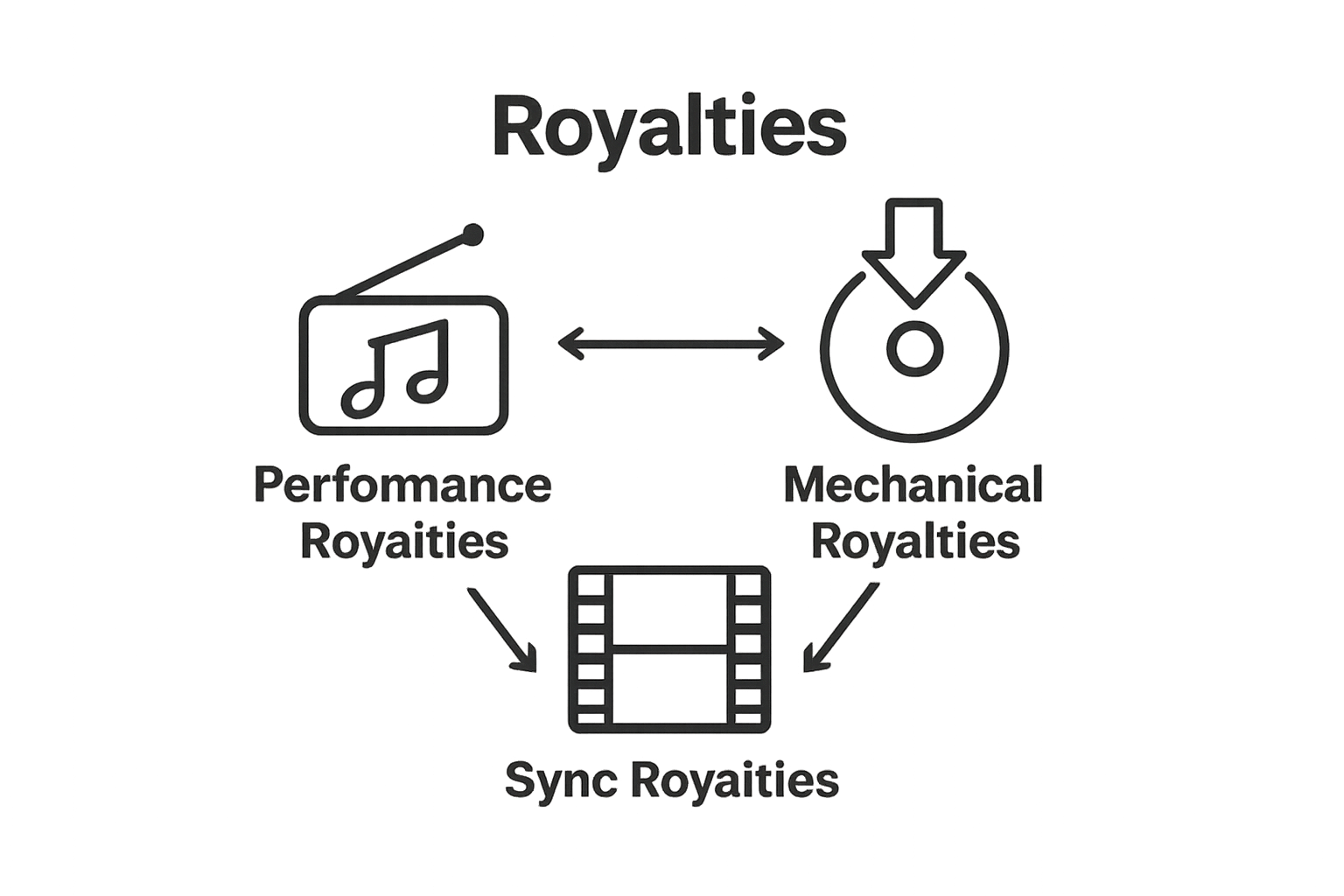
The complexity of royalties means they come in multiple flavours:
- Mechanical Royalties: Earned when your song is reproduced physically or digitally
- Performance Royalties: Generated when your music is played publicly
- Synchronisation Royalties: Paid when your music is used in film, TV, or advertisements
Why Songwriters Should Care About Royalties
For independent artists, royalties represent more than just money. They’re a recognition of artistic value and a critical mechanism for sustaining musical careers. Without a robust royalty system, songwriters would struggle to transform their passion into a viable profession.
Moreover, understanding royalties isn’t just about getting paid. It’s about protecting your creative rights and ensuring that your musical contributions are properly acknowledged. Whether you’re a bedroom producer or an established songwriter, comprehending the royalty landscape is crucial for your financial and professional growth.
If you’re keen to dive deeper into the world of music rights, read our comprehensive guide on copyright in music to arm yourself with the knowledge needed to navigate this intricate musical ecosystem.
The Different Types of Royalties in the Music Industry
Navigating the world of music royalties is like understanding a complex financial ecosystem where different streams of income flow to songwriters. Each type of royalty represents a unique pathway through which artists can monetise their musical creations, ensuring comprehensive compensation for their artistic work.
Below is a comparison table outlining the main types of royalties for songwriters, highlighting their sources and collection methods for better clarity.
| Royalty Type | What It Covers | How It Is Collected |
|---|---|---|
| Mechanical Royalty | Song reproduction (CDs, downloads, streaming) | Licensing agreements, mechanical licensing |
| Performance Royalty | Public performance (radio, live, streaming, venues) | Collected by Performance Rights Organisations |
| Synchronisation Royalty | Use in visual media (films, TV, adverts, games) | Negotiated for each sync placement |
| Print Royalty | Sales of sheet music and musical scores | Collected from publishers or sellers |
Performance and Mechanical Royalties: The Primary Income Streams
Performance royalties are generated when your music is played publicly. This includes radio airplay, live performances, streaming platforms, and even background music in cafes or public spaces. Mechanical royalties, on the other hand, are earned when your compositions are reproduced digitally or physically, such as through CD sales, digital downloads, or streaming services.
The nuances of these royalties can be intricate:
- Performance royalties are typically collected by Performance Rights Organizations (PROs)
- Mechanical royalties are often managed through specific licensing agreements
- Digital platforms have complex calculation methods for these payments
Synchronisation and Print Royalties: The Lesser-Known Earnings
Synchronisation royalties offer a fascinating revenue stream for songwriters. These are paid when your music is used in visual media like films, TV shows, advertisements, or video games. Each sync placement can represent a significant financial opportunity, turning your musical composition into a valuable asset beyond traditional listening platforms.
Print royalties, while less common in the digital age, still exist for sheet music and musical scores. If someone purchases or reproduces your written musical notation, you’re entitled to compensation.
For musicians looking to maximise their royalty potential, explore our comprehensive guide on music distribution to understand how to effectively monetise your musical creations across various platforms.
How Royalties Are Generated and Paid to Songwriters
Royalties aren’t magical money that appears out of thin air. They represent a complex, carefully orchestrated financial system designed to compensate musical creators for their intellectual property. Understanding this mechanism is crucial for songwriters who want to transform their musical talents into sustainable income.
The Role of Performance Rights Organizations
Performance Rights Organizations (PROs) are the critical intermediaries in the royalty ecosystem. These organisations track and collect payments whenever your music is publicly performed. Whether your song plays on Spotify, gets airtime on local radio, or echoes through a shopping centre’s speakers, PROs ensure you receive your rightful compensation.
The PRO tracking process involves several key steps:
- Registering your musical works with the organization
- Monitoring public performances across various platforms
- Collecting licensing fees from businesses and broadcasters
- Distributing royalties to registered songwriters and publishers
Digital Streaming and Mechanical Royalty Collection
In the digital age, streaming platforms have revolutionized how royalties are generated. Each stream represents a potential royalty payment, though the amounts can be frustratingly small. Digital services like Spotify and Apple Music negotiate complex licensing agreements with music publishers and record labels, which then determine how royalties are calculated and distributed.
The mechanical royalty collection process has been significantly streamlined by the Music Modernization Collective, which helps ensure more transparent and efficient payment mechanisms for songwriters.
If you’re looking to understand more about maximising your digital earnings, explore our comprehensive guide on music distribution to uncover strategies for optimizing your royalty potential.
Key Concepts and Terms Every Songwriter Should Know
Understanding the language of music royalties is as crucial as writing a hit song. Just like musicians learn scales and chords, songwriters must become fluent in the terminology that governs their financial ecosystem. This lexicon isn’t just academic jargon it’s the blueprint for protecting and monetising your musical creations.
Fundamental Royalty Terminology
At the heart of music royalties are several critical terms that every songwriter should master. Copyright represents the legal ownership of your musical work, granting you exclusive rights to reproduce, distribute, and perform your composition. Think of it as the intellectual property passport for your musical creativity.
Key terms that form the foundation of your royalty knowledge include:
The following table defines essential royalty-related terms every songwriter should know, offering concise explanations for quick reference.
| Term | Explanation |
|---|---|
| Copyright | Legal ownership of a musical work, granting exclusive rights to reproduce and use |
| Publishing Rights | Commercial rights associated with a musical composition |
| Master Recording | The original sound recording of a musical work |
| Composition | The actual musical notes and lyrics created by the songwriter |
| Writer’s Share | Portion of royalties directly attributed to the songwriter |
- Publishing Rights: The commercial rights associated with your musical composition
- Master Recording: The original sound recording of a musical work
- Composition: The actual musical notes and lyrics you’ve created
- Writer’s Share: The portion of royalties directly attributed to the songwriter
Complex Licensing and Collection Mechanisms
Licensing represents the formal permission granted to use your musical work. Different types of licenses unlock various revenue streams, from mechanical licenses for reproduction to synchronisation licenses for use in visual media. Understanding these nuanced agreements can mean the difference between getting paid and leaving money on the table.
The complexity of these mechanisms means songwriters must be both creative artists and savvy business professionals. Performance Rights Organizations (PROs) play a crucial role in tracking and collecting these varied royalty streams, acting as financial guardians for musical creators.
For a deeper dive into the intricate world of music industry terminology, check out our comprehensive musical terms guide and arm yourself with the knowledge to navigate this complex landscape.
The Impact of Digital Streaming on Songwriter Royalties
Digital streaming has radically transformed the music industry’s economic landscape, creating both unprecedented opportunities and significant challenges for songwriters. What once seemed like a revolutionary platform for music distribution has revealed complex financial realities that are reshaping how musicians earn their income.

The Economics of Streaming Royalties
Streaming platforms have fundamentally altered the traditional royalty model. Micropayments have replaced album sales, with artists receiving minuscule amounts per stream. A song might need thousands of plays to generate meaningful income, creating a stark economic equation that favours viral hits and established artists over emerging talents.
The streaming royalty structure presents several critical challenges:
- Extremely low per-stream payment rates
- Algorithmic playlists that prioritize certain artists
- Opaque royalty calculation mechanisms
- Disproportionate earnings between major labels and independent artists
Algorithmic Curation and Royalty Distribution
Modern streaming platforms rely heavily on algorithmic curation, which significantly impacts an artist’s earning potential. Playlist placement can mean the difference between earning pennies or generating substantial royalty income. These digital gatekeepers effectively determine which artists receive meaningful exposure and financial compensation.
The complexity of these systems means that songwriters must now understand not just musical composition, but also digital marketing, algorithmic trends, and streaming platform dynamics. It’s no longer enough to create great music you must also strategically navigate these digital ecosystems.
For musicians seeking to understand the intricacies of streaming economics, check out our detailed guide on how much streaming platforms pay per stream and arm yourself with the knowledge to maximize your digital earnings.
Empower Your Royalties with Music Gateway’s Tools for Songwriters
Understanding how royalties actually translate into earnings is only the starting point for serious songwriters. Many independent artists struggle to turn any real profit from streaming and mechanical royalties due to the complexities of digital platforms and industry practices. Navigating performance rights organisations, keeping track of synchronisation opportunities and making your song visible are all challenges highlighted in this guide. If you want your musical copyright, performance royalties and digital distribution efforts to directly impact your income, you need a partner who bridges every gap.
Music Gateway puts independent artists in control by providing easy access to professional music promotion, sync licensing, and distribution. Try our service and let your royalties work harder for you. Discover how our music promotion solutions make it simpler to get played, heard and paid. Take your next step towards a sustainable music career by joining the community at Music Gateway today.
Frequently Asked Questions
What are the different types of royalties for songwriters?
Royalties for songwriters primarily fall into three categories: mechanical royalties earned from the reproduction of songs, performance royalties generated from public performances, and synchronisation royalties paid for the use of music in visual media such as films and advertisements.
How are performance royalties collected and distributed?
Performance royalties are collected by Performance Rights Organizations (PROs), which track public performances of your music, collect licensing fees from businesses and broadcasters, and then distribute the collected royalties to registered songwriters and publishers based on performance data.
How has digital streaming affected songwriter royalties?
Digital streaming has transformed songwriter royalties by replacing traditional album sales with micropayments per stream. This shift can result in very low per-stream payments, demanding that songwriters receive a substantial number of plays to generate meaningful income.
What is the role of copyright in protecting a songwriter’s work?
Copyright provides legal ownership and exclusive rights to a songwriter’s musical creations, safeguarding their ability to reproduce, distribute, and perform their compositions while ensuring they are compensated for their intellectual property.